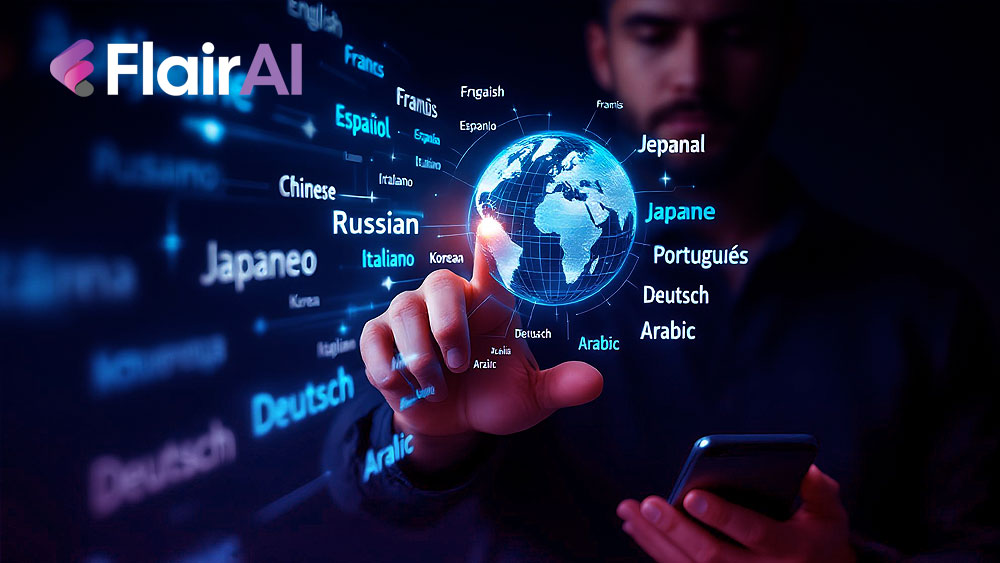
A growing share of website visitors don't speak the language a business writes in. For companies trying to expand beyond their home market, that's often the first real barrier, and it's one that used to require hiring multilingual staff or paying for translation on every piece of content. Multilingual AI has quietly changed that equation.
Rather than translating content once and hoping it stays relevant, a multilingual AI chat assistant can hold a live conversation in dozens of languages, adjusting in real time to whatever language the visitor types in, without a business needing a single extra hire.
Why this matters more than it used to
Online audiences are inherently international. A business selling from a UK website can easily attract visitors from across Europe, the Gulf, or further afield, often without actively marketing to them. If those visitors land on a site that only functions in English, a large proportion simply leave rather than struggle through a language barrier.
Multilingual AI removes that friction at the exact point it matters most: the conversation. A visitor can ask a question in their own language and get an accurate, natural-sounding answer immediately, rather than relying on browser translation tools that often mangle technical or industry-specific terms.
Real-time translation vs static translated pages
Translating a website's static pages is still worthwhile, but it only covers what's already been written. Live chat is different: customers ask unpredictable questions, and a multilingual AI assistant trained on the business's own data can answer those questions accurately in the visitor's language, not just in whatever languages the marketing team happened to translate in advance.
Where multilingual AI has the biggest impact
- Pre-sales enquiries from international visitors who would otherwise bounce off the site
- Customer support for existing customers based in other countries or regions
- Businesses expanding into new markets without the budget for a local support team on day one
- Events, exhibitions, or seasonal demand spikes that bring in a wider international audience
Accuracy is the part that matters most
Not all AI translation is equal. Generic translation tools work word for word and often lose meaning in technical or industry-specific contexts. A multilingual AI assistant trained specifically on a business's own products, terminology, and documentation is far more likely to give visitors an accurate, useful answer rather than a literal but confusing one.
What businesses need to get right
The biggest risk with multilingual AI isn't the technology, it's assuming it works the same for every language without checking. Some languages and dialects are better supported than others, and a business serving a specific international market should test conversations in that language before relying on it fully.
It's also worth deciding early which languages actually matter for the business. Supporting every language available isn't usually the goal; supporting the languages of the audiences a business genuinely wants to reach is.
Combining multilingual AI with human backup
As with any AI deployment, the strongest setups combine automated multilingual responses with a clear path to a human when something needs more nuance, particularly for languages where the business doesn't have native-speaking staff on hand to double-check tone or accuracy.
The bottom line
For businesses with any international ambition, multilingual AI turns a website from something that only works for one language audience into something that can genuinely serve a global one. It's one of the more immediately measurable wins in AI adoption, because the impact shows up directly in how many international visitors actually convert into customers.
If reaching international audiences is part of your growth plan, FlairAI's chat solutions include real-time multilingual support built into the same trained assistant your existing customers already use. Get in touch to see it in action.